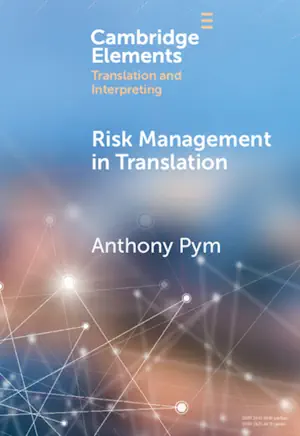
Book Review
A recent addition to Cambridge University Press's Elements in Translation and Interpreting series is Risk Management in Translation, authored by Anthony Pym, one of the world's foremost translation studies scholars (Ioannidis, 2024). In this concise but insightful volume, Pym presents and analyses a topic of immense academic and practical relevance which synthesises and develops aspects touched upon in some of his previous research (e.g., see Pym, 2015).
Risk Management in Translation is divided in six sections. The first, entitled 'Why talk about risk?' (pp. 1-8), highlights the inherent uncertainty underlying (multilingual) communication. Pym goes beyond traditional rule-based notions of equivalence, highlighting that in many areas of translation, the "problems of translating a text do not have clear, simple solutions" (Pym, 2025a, p. 1). In discussing the role of risk and probability in numerical economic and business-related contexts, Pym then delineates how risk management interplays with the translator's craft, and how – consciously or not – it may affect a translator's work and mindset. As such, the importance of cooperation in enhancing the probability of a successful outcome – as well as in the avoidance of failure – is underscored.
The second section, 'The risk of what?' (pp. 8-17), summarises the factors that underpin successful intercultural communication (and by extension translation) given its potential susceptibility to risk. Utilising different case studies, Pym presents how notions of success and failure can potentially be measured in instances of translation or interpreting, even though certain of these 'successes' may not conform to specific or generally-recommended guidelines. Pym centres his attentions on the "local decision-making process, between the people and factors considered pertinent by the decision maker" (Pym, 2025a, p. 14), looking inter alia at the fluid nature of cooperation, and the economic rationale underpinning why certain things may (or may not) need to be translated in full.
In the third section, 'Types of risk management' (pp. 18-31), Pym outlines some of the major strategies underpinning risk management. Always in the context of translation and interpreting, these include brief presentations of strategies to avoid risk, information about the transfer of risks, as well as when and how both to take risks or when to use trade-offs in professional practice. These insights not only discussed in the context of the appropriate scholarly literature but are additionally enriched with references to Pym's wealth of professional translation experience, thereby incorporating judicious examples from real-life practice.
Section four, 'Trust as risk management' (pp. 31-38), notes that trust represents "the social glue that enables cooperation to extend over time" (Pym, 2025a, p. 31). In applying this to translation and interpreting, Pym details the importance of quality and credibility – i.e., relating to appropriate linguistic and subject-specific knowledge and skills. Pym also presents the concept of 'thick' and 'thin' trust – i.e., whether a professional is considered to be trusted across many domains or only in one exclusive area. Lastly, Pym also outlines distrust, a concept which he advances as being much stronger than simply a mere lack of trust.
The penultimate section, 'Risks in automated translation' (pp. 38-50), can be considered especially relevant to our modern age. Here, Pym outlines some of the different technologies and the risks inherent in them (from machine translation and translation memories to neural machine translation and onwards). He articulates some of the issues that could arise, including the need for consumers to be protected and the risks of data loss through breaches, as well as aspects relating to risk assessment and the speed and accuracy of such systems in time-restricted emergency contexts. Conscious of the evolving role of translators in the future, he also usefully presents some helpful pointers for mitigating some of the risks of automation in the language sphere, including practical steps regarding the pre-editing and post-editing of documents, the creation of relevant templates, as well as on potential ways to revise AI texts.
In the work's conclusion, 'A case for more risk-taking' (pp. 50-57), Pym reiterates the centrality of cooperation to his understanding of risk management in translation, observing how things are changing because of the increased utilisation of online tools and the ensuing access to myriad translation possibilities by non-specialists. Accordingly, the Element concludes with a series of recommendations, which include teaching the risks of automation as well as the acceptance that translation has now become open to all. In addition, in terms of future trends, Pym advises that translators focus on high-stakes situations, as well as on enhancing creative transformation and the development of 'thick' trust relations – i.e., as mentioned previously, across a variety of sectors, rather than just one.
In sum, this short volume provides an eminently skilful and up-to-date summary of an important and relevant topic which – as the author has anticipated in a recent position paper (see Pym, 2025b) – will doubtlessly provide material for further comment and debate. The insights are delivered in Pym's characteristic reader-conscious style, which presents and discusses with the subject matter with verve and aplomb. Though aimed at an academic audience of scholars, researchers, and students, the analysis and observations contained in Risk Management in Translation will also be a must-read for practicing translators and interpreters seeking to adapt to the present era of change, as well as those involved in organising, contracting, and utilising multilingual communication services.
References
- Ioannidis, J. P. A. (2024). August 2024 data-update for "Updated science-wide author databases of standardized citation indicators". Elsevier Data Repository, V7. https://doi.org/10.17632/btchxktzyw.7
- Pym, A. (2015). Translating as risk management. Journal of Pragmatics, 85, 67-80. https://doi.org/10.1016/j.pragma.2015.06.010
- Pym, A. (2025a). Risk management in translation. Cambridge University Press. https://doi.org/10.1017/9781009546836
- Pym, A. (2025b). Risk management in translation: A reply to critics. Knowledge Commons. https://doi.org/10.17613/060cy-amp18